15 Topics
 5 Days
 60 Sessions
Programme Overview
Training Description
This course is designed for farmers, agricultural extension officers, environmental consultants, policymakers, and sustainability professionals. This includes Farmers, Agricultural Consultants, Environmental Scientists, Land Managers, Sustainability Officers, Agricultural Extension Officers, Farm Managers, Policy Makers, Researchers, and NGO Staff. These individuals require expertise in regenerative agriculture to implement sustainable farming practices and improve ecosystem health.
Session Objectives
- Understand the principles and benefits of regenerative agriculture. Implement no-till and minimum tillage techniques to improve soil structure. Utilize cover cropping to enhance soil fertility and reduce erosion. Apply holistic grazing practices to restore grasslands and enhance biodiversity. Develop strategies for building soil organic matter and sequestering carbon. Understand the role of composting and biofertilizers in regenerative agriculture. Implement agroforestry systems to integrate trees into farming landscapes. Analyze the impact of regenerative agriculture on water management and conservation.
About the Course
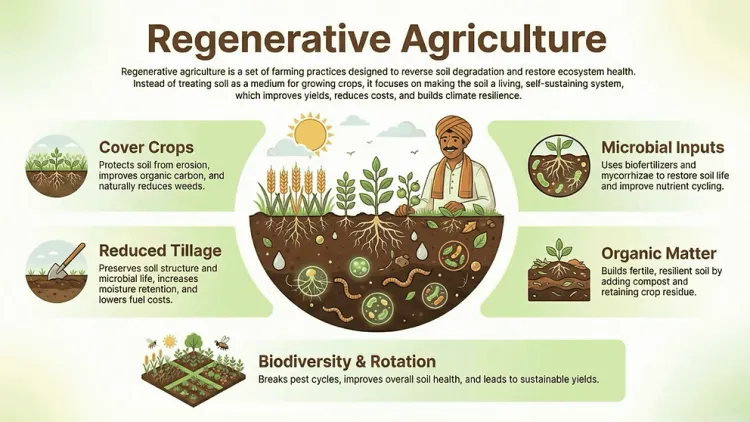
Regenerative Agriculture Practices equips professionals with the knowledge and skills to restore soil health, enhance carbon sequestration, and revitalize ecosystems. This course focuses on implementing sustainable farming techniques that go beyond minimizing harm, aiming to actively improve environmental conditions. Participants will learn to apply practices like no-till farming, cover cropping, and holistic grazing to build resilient agricultural systems. By mastering regenerative agriculture, professionals can contribute to climate change mitigation, improve farm productivity, and enhance biodiversity.
Curriculum & Topics
15 Topics | 60 Sessions
-
 Workshop 1.1:
Defining and differentiating regenerative agriculture.
Workshop 1.1:
Defining and differentiating regenerative agriculture.
-
Workshop 1.2:
Exploring core principles: soil health, biodiversity, context, integration, feedback loops.
-
Workshop 1.3:
Understanding ecological, social, and economic benefits.
-
Workshop 1.4:
Setting the stage for a holistic approach.
-
Workshop 2.1:
Understanding the soil food web.
-
Workshop 2.2:
Analyzing soil health indicators.
-
Workshop 2.3:
Importance of soil organic matter (SOM) for carbon sequestration.
-
Workshop 2.4:
Assessing and diagnosing soil degradation.
-
Workshop 3.1:
Implementing no-till and minimum tillage techniques.
-
Workshop 3.2:
Selecting appropriate equipment.
-
Workshop 3.3:
Managing crop residues and weed control.
-
Workshop 3.4:
Measuring impact on soil structure and water infiltration.
-
Workshop 4.1:
Selecting diverse cover crop species.
-
Workshop 4.2:
Designing effective rotations and mixes.
-
Workshop 4.3:
Implementing termination methods.
-
Workshop 4.4:
Integrating cover crops into rotations.
-
Workshop 5.1:
Understanding holistic planned grazing.
-
Workshop 5.2:
Developing grazing plans.
-
Workshop 5.3:
Monitoring and managing livestock.
-
Workshop 5.4:
Integrating livestock into landscapes.
-
Workshop 6.1:
Creating high-quality compost.
-
Workshop 6.2:
Understanding and applying biofertilizers.
-
Workshop 6.3:
Enhancing nutrient cycling.
-
Workshop 6.4:
On farm input production.
-
Workshop 7.1:
Designing diverse agroforestry systems.
-
Workshop 7.2:
Selecting appropriate tree species.
-
Workshop 7.3:
Integrating trees with crops and livestock.
-
Workshop 7.4:
Harvesting and processing tree products.
-
Workshop 8.1:
Implementing water harvesting techniques.
-
Workshop 8.2:
Utilizing regenerative irrigation.
-
Workshop 8.3:
Water management in arid climates.
-
Workshop 8.4:
Building soil water holding capacity.
-
Workshop 9.1:
Understanding livestock's role in regenerative systems.
-
Workshop 9.2:
Implementing rotational grazing.
-
Workshop 9.3:
Managing livestock manure.
-
Workshop 9.4:
Addressing animal welfare.
-
Workshop 10.1:
Creating habitats for pollinators.
-
Workshop 10.2:
Promoting natural pest control.
-
Workshop 10.3:
Understanding native plant species.
-
Workshop 10.4:
Measuring on farm biodiversity.
-
Workshop 11.1:
Conducting visual soil assessments.
-
Workshop 11.2:
Utilizing soil testing.
-
Workshop 11.3:
Developing soil health management plans.
-
Workshop 11.4:
Using technology for monitoring.
-
Workshop 12.1:
Analyzing economic benefits.
-
Workshop 12.2:
Identifying market opportunities.
-
Workshop 12.3:
Navigating certification programs.
-
Workshop 12.4:
Developing farm business plans.
-
Workshop 13.1:
Developing a transition plan.
-
Workshop 13.2:
Overcoming challenges.
-
Workshop 13.3:
Utilizing adaptive management.
-
Workshop 13.4:
Building supportive networks.
-
Workshop 14.1:
Analyzing real-world examples.
-
Workshop 14.2:
Highlighting innovative techniques.
-
Workshop 14.3:
Documenting impacts.
-
Workshop 14.4:
Farmer interviews and tours.
-
Workshop 15.1:
Exploring emerging trends.
-
Workshop 15.2:
Understanding policy and incentives.
-
Workshop 15.3:
Discussing technology and research.
-
Workshop 15.4:
Building resilient food systems.