7 Topics
 5 Days
 35 Sessions
Programme Overview
Training Description
- Public-sector risk and compliance professionals
- Governance and accountability professionals
- ICT and digital-transformation professionals
- Revenue-management professionals
- Public-sector project managers
- Policy and regulatory professionals
- Development-sector finance professionals
- Senior government officials and executives
- Professionals involved in public financial management reform
Session Objectives
- Understand the core principles of blockchain technology and its relevance to public finance. Identify key areas in public budgeting and expenditure where blockchain can be applied. Develop a strategic framework for a pilot blockchain project. Assess the potential benefits and risks of blockchain implementation. Explore smart contract applications for automating budget rules and payments
About the Course
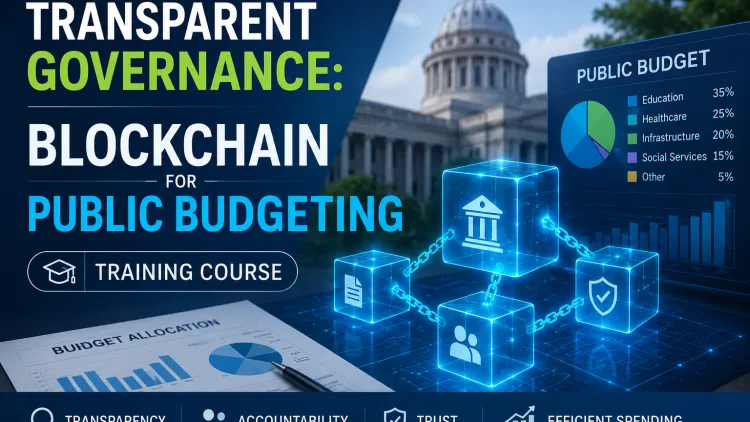
Blockchain for Public Budgeting & Financial Governance is a forward-looking professional training course designed to equip public-sector finance, budgeting, accounting, audit, procurement, governance, and technology professionals with an understanding of how blockchain and distributed ledger technology can strengthen public financial management.The course explores how blockchain can improve budget transparency, expenditure tracking, procurement integrity, financial reporting, auditability, inter-agency coordination, and public accountability. Participants will examine practical applications, benefits, limitations, governance considerations, cybersecurity risks, data privacy issues, and implementation strategies for integrating blockchain into public budgeting and financial-management systems.
Curriculum & Topics
7 Topics | 35 Sessions
-
 Workshop 1.1:
Introduction to distributed ledger technology (DLT).
Workshop 1.1:
Introduction to distributed ledger technology (DLT).
-
Workshop 1.2:
How blockchain creates trust and immutability.
-
Workshop 1.3:
Public vs. private vs. consortium blockchains.
-
Workshop 1.4:
Smart contracts: logic and automation.
-
Workshop 1.5:
A deep dive into core blockchain concepts like hashing and consensus.
-
Workshop 2.1:
Current limitations of traditional budgeting systems.
-
Workshop 2.2:
The role of accountability and trust in public finance.
-
Workshop 2.3:
Identifying vulnerabilities to fraud and mismanagement.
-
Workshop 2.4:
Case studies of transparency initiatives around the world.
-
Workshop 2.5:
The demand from citizens for greater accountability.
-
Workshop 3.1:
Tracking public funds from tax collection to final expenditure.
-
Workshop 3.2:
Enhancing transparency in public procurement.
-
Workshop 3.3:
Automating grant and aid distribution.
-
Workshop 3.4:
Improving auditability and reducing manual processes.
-
Workshop 3.5:
Managing public asset registries.
-
Workshop 4.1:
Defining the problem and project scope.
-
Workshop 4.2:
Choosing the right blockchain platform for the use case.
-
Workshop 4.3:
Designing the data model and smart contract logic.
-
Workshop 4.4:
Integrating blockchain with existing legacy systems.
-
Workshop 4.5:
Building a proof-of-concept.
-
Workshop 5.1:
Data privacy and General Data Protection Regulation (GDPR) on the blockchain.
-
Workshop 5.2:
Managing blockchain access and permissions.
-
Workshop 5.3:
The importance of a clear governance model.
-
Workshop 5.4:
Regulatory considerations for public sector blockchain projects.
-
Workshop 5.5:
Best practices for securing a blockchain network.
-
Workshop 6.1:
Developing a project roadmap and implementation plan.
-
Workshop 6.2:
Communicating the value of the project to stakeholders.
-
Workshop 6.3:
Managing change and training for public employees.
-
Workshop 6.4:
Overcoming political and organizational challenges.
-
Workshop 6.5:
Measuring and demonstrating return on investment.
-
Workshop 7.1:
The role of decentralized autonomous organizations (DAOs).
-
Workshop 7.2:
Interoperability between different government blockchains.
-
Workshop 7.3:
Exploring identity management and digital citizenship.
-
Workshop 7.4:
Emerging trends and future possibilities.
-
Workshop 7.5:
The path forward for transforming public financial management.